Toddler Program
(18 months - 3 years)

Birth to three is the most important time in a child’s life.  Dr. Montessori said that during this time, we must free the child to go on with his task of self-creation.  Our foundation in the Toddler Program is to assist the child in self-creation. Our uniquely prepared toddler environment meets the young child's need for self-creation. 

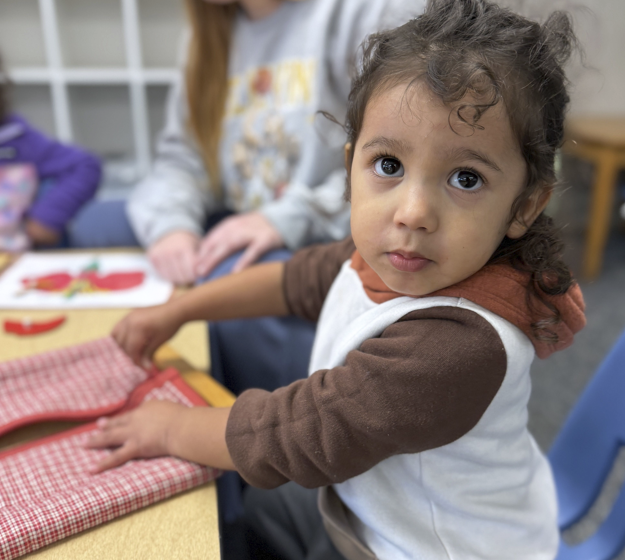
This class is designed to assist each child toward independence, social awareness, respect, development of motor skills, and development of language.  Toddlers have opportunities to meet their physical, social, and emotional needs. The classroom exercises include sensorial work, practical life activities, math, language, music, arts, and cultural subjects.

In many instances, this is the first experience the child has of being a member of his own "society." The child is encouraged to be an important functioning member of this society, thus leading him to a feeling of pride and dignity. Waiting one's turn, sharing, and patience are important lessons that each child learns.

The Montessori teacher offers the tenderness, warmth and patience so essential at this age. An emphasis on the importance of a peaceful environment, along with the necessary nurturing and caring, are characteristics of this program.

The Toddler Program is multi-aged.  The younger child observe the older toddlers and are intrinsically motivated to do what they see them doing.  The older children are delighted in their new-found skills and help the younger children, which in turn fosters their self esteem.

Each classroom has a routine that can be observed as we transition activities throughout the day.  Children are potty-trained they when he or she shows signs of readiness. Teachers will positively assist every child to become successful in using the toilet.

Nutrition is important with our growing Toddlers. Children are often encouraged to eat their meals independently. If needed, the caring teachers will help each child during meals.

The child who completes the Toddler Program will be independent, self confident, and ready to move to the next level.


Practical Life

  • Coordination of movement and Exercises for Large Muscle Groups: jumping, climbing, dance, running, walking, carrying exercises etc.
  • Hand-eye coordination and Exercises for Small Muscle Groups: bead stringing, pegs, puzzles, gluing, folding, pouring, transferring, spooning, grasping.
  • Care of Self: dressing frames, hand washing, combing hair, wiping face. Care of Environment and Grace and Courtesy: sweeping, wiping table, setting table.
  • Grace and Courtesy: table manners, saying "thank you", "please", and other kind words.
Sensorial
  • Color of the Month: emphasis on a color. Art activities, sorting, matching exercises are based on a chosen color for the month.
  • Weight, textures, sounds, dimensions, and taste
Language
  • Building Vocabulary- Classified vocabulary
  • Calendar- Days of the Week and Months of the Year
  • Story Books: There is a book selection of the month. Most of the books we review are Caldecott Award winning books.
  • Music and Finger plays
  • Felt Story Board
Book Samples
Color of the Month

September:

School Bus by Donald Crews

Yellow

October:

Where the Wild Things Are by Maurice Sendak

Black and Orange

November:

Brown Bear, Brown Bear, What do You See? by Eric Carle

Brown

December:

Freight Trains by Donald Crews

Red

January:

Snow by Uri Shulevitz

White

February:

Little Pink Pig by Pat Hutchins

Pink

March:

Little Blue and Little Yellow by Lois Elhert

Green

April:

Raindrop Splash by Alvin Tresselt

Blue

May:

Waiting for Wings by Lois Elhert

Purple

June:

A Color of His Own by Leo Lionni

All Colors

Math
  • Counting games, Calendar
  • Number of the Month: associating quantity to symbol

Cultural
  • Artist of the Month - Brief introduction to the Masters. Children are exposed to the different masterpieces.
  • Composer of the Month- Children listen to the music by selected composer.
  • Geography - Brief introduction to the continents through song, pictures, games and art work.
  • Botany and Zoology - learning about plants and animals. Gardening and care of classroom pets.
Enrichment
  • Spanish and Sign Language
  • Art
  • Music